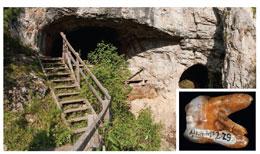
The ice-age world is starting to look cosmopolitan. While Neanderthals held sway in Europe and modern humans were beginning to populate the globe, another ancient human relative lived in Asia, according to a genome sequence recovered from a finger bone in a cave in southern Siberia. A comparative analysis of the genome with those of modern humans suggests that a trace of this poorly understood strand of hominin lineage survives today, but only in the genes of some Papuans and Pacific islanders.
More here: http://www.nature.com/news/2010/101222/full/4681012a.html
And Discovery News: http://news.discovery.com/human/human-ancestor-bred-neanderthals-siberia-101222.html
Showing posts with label DNA. Show all posts
Thursday, December 23, 2010
Fossil genome reveals ancestral link
Labels:
admixture,
Denisova Cave,
Denisovans,
DNA,
interbreeding,
neanderthal
Saturday, March 14, 2009
Mayorga and Haplogroup R1b1b2
Marge’s dad just got back the Y-DNA results from the National Geographic's Genographic Project and it turns out he is Haplogroup R1b1b2 (formerly R1B1c), which is pretty common throughout Europe, but very common in the Iberian Peninsula. Here are some stats from Wikipedia:
Welsh 89%, Basque 88%, Irish 81%, Northern Portuguese 81%, Catalan 79%, Scottish 77%, English 75%, other Spanish 70%, Dutch 70%, Belgians 63%, Southern Portuguese 60%, Ossetians 43%, Italian 40%, German 39%
While doing some research on the Mayorga surname, which comes from a town in Spain and is a common surname in Nicaragua, I found this possible ancestor:
"Don Alonso Diaz de Mayorga y Arregui was born in Seville during the first half of the sixteenth century. His father was from Old Castile and his mother was Basque. He arrived in Nicaragua around 1608 and actively participated in the design of the new city Santiago de los Caballeros de León as the previous city had been destroyed by the eruption of the volcano, Momotombo, which forced the residents and authorities to seek a new site for relocating the city. It was relocated as the new town, consolidated on the site is now known as Santiago de los Caballeros de León. Don Alonso was one of those who collaborated on the layout of the streets of the new city, the location of the new church and buildings that would house the offices of the new authorities."
It seems most Nicaraguen Mayorgas are decended from Don Alonso Díaz de Mayorga y Arregui. The "Díaz de Mayorga" surname survived for like 9 generations before getting shortened to just Mayorga.
Welsh 89%, Basque 88%, Irish 81%, Northern Portuguese 81%, Catalan 79%, Scottish 77%, English 75%, other Spanish 70%, Dutch 70%, Belgians 63%, Southern Portuguese 60%, Ossetians 43%, Italian 40%, German 39%
While doing some research on the Mayorga surname, which comes from a town in Spain and is a common surname in Nicaragua, I found this possible ancestor:
"Don Alonso Diaz de Mayorga y Arregui was born in Seville during the first half of the sixteenth century. His father was from Old Castile and his mother was Basque. He arrived in Nicaragua around 1608 and actively participated in the design of the new city Santiago de los Caballeros de León as the previous city had been destroyed by the eruption of the volcano, Momotombo, which forced the residents and authorities to seek a new site for relocating the city. It was relocated as the new town, consolidated on the site is now known as Santiago de los Caballeros de León. Don Alonso was one of those who collaborated on the layout of the streets of the new city, the location of the new church and buildings that would house the offices of the new authorities."
It seems most Nicaraguen Mayorgas are decended from Don Alonso Díaz de Mayorga y Arregui. The "Díaz de Mayorga" surname survived for like 9 generations before getting shortened to just Mayorga.
Friday, February 15, 2008
Haplogroup A and the Nicarao People
My wife's genetic test from National Geographic finally came in and she belongs to the mitochondrial Haplogroup A.
This group originated in Asia and is shared by a 10% of the Han Chinese, 7.7% of Koreans and Japanese, and the Chukchi people of Siberia.
In North America it accounts for the majority of the Eskimo-Aleut populations. In the Southwest United States it's assosiated with the Apache and the Navajo. In Central America with the Maya and in South America with the Inca.

Since my wife is Nicaraguan (Central American), it's safe to say she's of Nicarao descent. There is linguistic evidence that the Nicarao people are related to the Mayans. Although the Mayan empire didn't really reach Nicaragua (there are no Maya ruins in the country) it seem a large group broke of and headed south. Pretty awesome!
This group originated in Asia and is shared by a 10% of the Han Chinese, 7.7% of Koreans and Japanese, and the Chukchi people of Siberia.
In North America it accounts for the majority of the Eskimo-Aleut populations. In the Southwest United States it's assosiated with the Apache and the Navajo. In Central America with the Maya and in South America with the Inca.
Since my wife is Nicaraguan (Central American), it's safe to say she's of Nicarao descent. There is linguistic evidence that the Nicarao people are related to the Mayans. Although the Mayan empire didn't really reach Nicaragua (there are no Maya ruins in the country) it seem a large group broke of and headed south. Pretty awesome!
Friday, December 21, 2007
My DNA Revisited
I’ve got additional information concerning my own personal blue print. It seems my grandfather on my mom’s side was Haplogroup E3b, mostly associated with the Berbers (Moors) of North Africa and Spain. Even though I can’t really be tested for it, since I get my Y chromosome from my dad’s side of the family, my uncle got tested through the National Geographic Genographic Project. Ultimately, I am 25% Berber/Moor, which explains why I don’t look particularly Scandinavian as both my Y and Mitochondrial DNA suggests.
On a rather cool note, genetic testing of the mummy of Ramses II shows that he was also of Haplogroup E3b. It is also known that he had 110 children! If you increase that exponentially over time, chances are my grandfather (and myself) could very well be distant descendants of Ramses the Great.
Saturday, November 10, 2007
My DNA
This year I participated in the National Geographic's Genographic Project and I found out that the DNA gotten from my dad’s side of the family is Haplogroup I1a. To quote the great Wikipedia, “I1a is a Y-chromosome haplogroup occurring at greatest frequency in Scandinavia. It displays a very clear frequency gradient, with a peak frequency of approximately 35% among the populations of southern Norway, southwestern Sweden, and Denmark, and rapidly decreasing frequencies toward the edges of the historically Germanic-influenced world.” Needless to say I found this to be rather odd. If you know me, you know that I don’t look particularly Nordic. So I figured I took after my mother’s side of the family... until I got my mitochondrial DNA results, which turned out to be Haplogroup U4 and to quote Oxford Ancestors, “U4 is found today mainly in the east and north of Europe with particularly high concentrations in Scandinavia and the Baltic states." What the -? It's the same thing!
Some background information: The Hernandez family (my branch of it anyway) went from Spain to the Canary Islands to Cuba and then to Miami. Looking at Spanish history it’s not so strange to find out we’re part of Haplogroups I1a and U4 when you think that Spain was occupied, and in some cases permanently settled, by Germanic Tribes such as the Vandals, the Suebi, and the Visigoths, all of which originated in the Baltic area. Spain was also frequently raided by Vikings, which were known for their enthusiastic raping as well as pillaging.
Labels:
Canary Islands,
Cuba,
DNA,
Haplogroup I,
Spain,
Visigoths
Subscribe to:
Posts (Atom)